FOUNDATIONS OF AUTONOMOUS DIGITAL ECOSYSTEMS
Article Sidebar
Main Article Content
Abstract
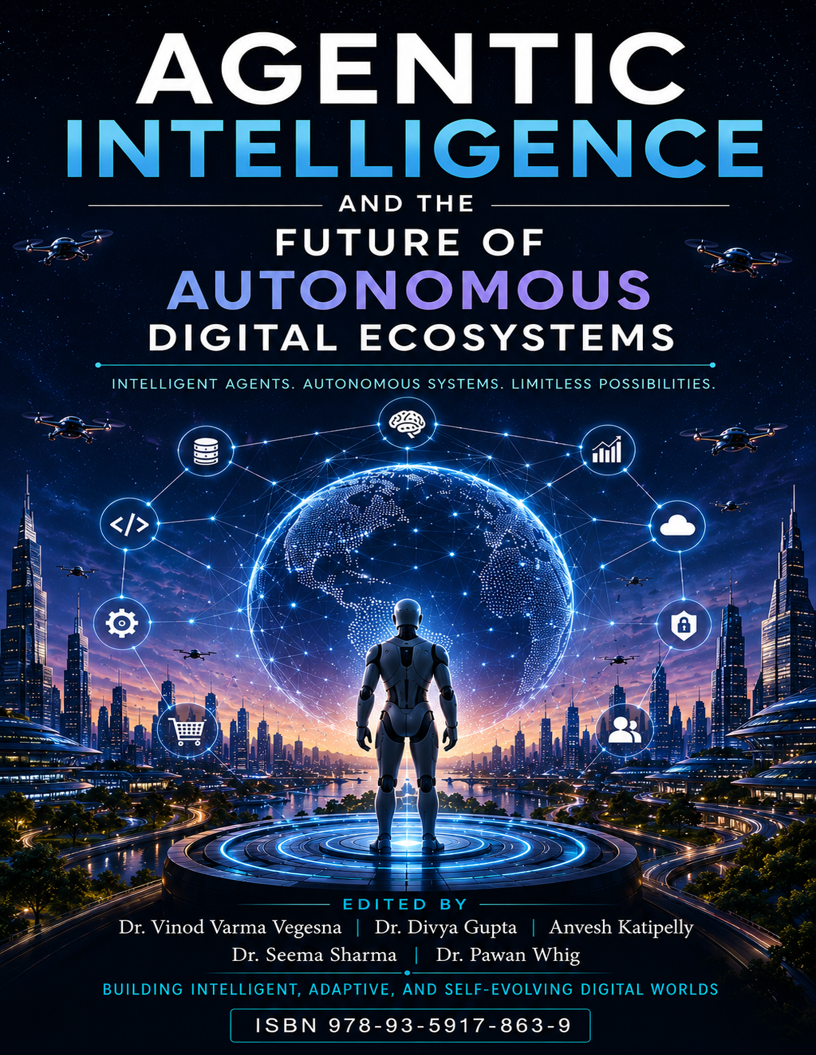
Autonomous Digital Ecosystems (ADEs) represent a transformative convergence of artificial intelligence, distributed computing, cyber-physical integration, and self-organising network architectures that collectively enable digital environments to perceive, reason, adapt, and act without sustained human intervention. Unlike earlier computational paradigms that required continuous human oversight, manual configuration, and reactive maintenance, ADEs autonomously sustain operational integrity, optimise resource allocation, respond dynamically to environmental perturbations, and evolve their functional capabilities in response to changing contextual demands. At the architectural level, ADEs comprise four interdependent foundational layers: a perceptual substrate that aggregates and pre-processes heterogeneous data streams from physical sensors, software telemetry, and networked sources; a cognitive layer housing AI-driven reasoning, planning, and decision-making engines; an actuation layer translating cognitive outputs into coordinated actions across physical and digital actuators; and a governance layer enforcing operational constraints, alignment objectives, transparency requirements, and regulatory compliance conditions. The functional coherence of these layers is sustained through continuous feedback loops, adaptive learning mechanisms, and inter-agent communication protocols that collectively instantiate the self-regulating, goal-directed behaviour that defines genuine autonomy. Empirical evidence from early ADE deployments in smart city infrastructure, industrial IoT platforms, autonomous financial trading ecosystems, and federated healthcare networks demonstrates compelling performance advantages—including latency reductions of 40–65%, operational cost decreases of 25–38%, and fault recovery times reduced by over 70% compared to conventionally managed digital systems. However, the realisation of fully autonomous digital ecosystems also introduces profound challenges encompassing algorithmic accountability, emergent behavioural unpredictability, cybersecurity vulnerability surfaces, regulatory compliance complexity, and the governance of systems whose operational logic may exceed the interpretive capacity of their human overseers. This chapter provides a comprehensive scholarly analysis of ADE foundations, applications, methodologies, case evidence, limitations, and future directions, establishing the conceptual architecture necessary for the advanced topics examined in subsequent chapters.
Article Details
References
Janakiraman, A. (2025). Muti-agent Generative Systems in E-commerce recommendations and pricing. Australian Journal of Cross-Disciplinary Innovation, 7(7).
Janakiraman, A. (2025). Leveraging Machine Learning for Equitable Green Innovation. In Advancing Social Equity Through Accessible Green Innovation (pp. 351-372). IGI Global Scientific Publishing.
AI-Driven Predictive Analytics for Sustainable Smart City Development. (2026). International Conference on Data Science, Data Engineering, Security & Healthcare for Sustainable Development 2026 , 1(1). https://publication.huntfortalent.org/index.php/book2/article/view/15
BIG DATA ANALYTICS FOR SUSTAINABLE AGRICULTURE, ENERGY, AND ENVIRONMENTAL MONITORING. (2026). International Conference on Data Science, Data Engineering, Security & Healthcare for Sustainable Development 2026 , 1(1). https://publication.huntfortalent.org/index.php/book2/article/view/19
OpenAI. (2023). GPT-4 technical report. https://arxiv.org/abs/2303.08774
Minsky, M. (1986). The society of mind. Simon & Schuster.
Newell, A., & Simon, H. A. (1976). Computer science as empirical inquiry: Symbols and search. Communications of the ACM, 19(3), 113–126.
Silver, D., Schrittwieser, J., Simonyan, K., Antonoglou, I., Huang, A., Guez, A., Hubert, T., Baker, L., Lai, M., Bolton, A., Chen, Y., Lillicrap, T., Hui, F., Sifre, L., van den Driessche, G., Graepel, T., & Hassabis, D. (2017). Mastering Chess and Shogi by self-play with a general reinforcement learning algorithm. arXiv. https://arxiv.org/abs/1712.01815
Silver, D., Hubert, T., Schrittwieser, J., Antonoglou, I., Lai, M., Guez, A., Lanctot, M., Sifre, L., Kumaran, D., Graepel, T., Lillicrap, T., Simonyan, K., & Hassabis, D. (2018). A general reinforcement learning algorithm that masters chess, shogi, and Go through self-play. Science, 362(6419), 1140–1144.
Bommasani, R., Hudson, D. A., Adeli, E., Altman, R., Arora, S., von Arx, S., Bernstein, M., Bohg, J., Bosselut, A., Brunskill, E., Brynjolfsson, E., & Liang, P. (2021). On the opportunities and risks of foundation models. Stanford University.
Yao, S., Zhao, J., Yu, D., Du, N., Shafran, I., Narasimhan, K., & Cao, Y. (2023). ReAct: Synergizing reasoning and acting in language models. arXiv. https://arxiv.org/abs/2210.03629
Shinn, N., Cassano, F., Berman, E., Gopinath, A., Narasimhan, K., & Yao, S. (2023). Reflexion: Language agents with verbal reinforcement learning. arXiv. https://arxiv.org/abs/2303.11366
Wang, X., Wei, J., Schuurmans, D., Le, Q. V., Chi, E., Narang, S., Chowdhery, A., & Zhou, D. (2023). Self-consistency improves chain of thought reasoning in language models. arXiv. https://arxiv.org/abs/2203.11171
Park, J. S., O'Brien, J., Cai, C. J., Morris, M. R., Liang, P., & Bernstein, M. S. (2023). Generative agents: Interactive simulacra of human behavior. Proceedings of the ACM Symposium on User Interface Software and Technology.
Xi, Z., Chen, W., Guo, X., He, W., Wang, Y., Zhang, W., Li, X., & Chen, H. (2023). The rise and potential of large language model based agents: A survey. arXiv. https://arxiv.org/abs/2309.07864
Wang, L., Ma, C., Feng, W., Zhang, Y., Liu, Z., Zhao, H., Tang, J., & others. (2024). A survey on large language model based autonomous agents. Frontiers of Computer Science, 18(6).
Franklin, S., & Graesser, A. (1997). Is it an agent, or just a program? A taxonomy for autonomous agents. Intelligent Agents III, 21–35.
Konda, P. (2019). Cloud-Native Data Migration Frameworks for Modernizing Legacy Warehouses into Cloud Platforms. International Journal of Sustainable Development in Computing Science, 1(1). Retrieved from https://www.ijsdcs.com/index.php/ijsdcs/article/view/698
Konda, P. (2019). Enterprise Data Lakehouse Adoption: Challenges, Solutions, and Best Practices. International Journal of Machine Learning for Sustainable Development, 1(2). Retrieved from https://www.ijsdcs.com/index.php/IJMLSD/article/view/700
Konda, P. R. (2019). Performance Benchmarking of Legacy Data Warehouse Platforms vs Cloud Data Warehouse Platforms for Large-Scale Analytical Workloads. International Meridian Journal, 1(1). https://meridianjournal.in/index.php/IMJ/article/view/115
Konda, P. R. (2020). Scalable Lakehouse Architectures Using Bronze-Silver-Gold Modeling for Enterprise Analytics. International Meridian Journal, 2(2). https://meridianjournal.in/index.php/IMJ/article/view/116