ETHICAL, LEGAL, AND REGULATORY DIMENSIONS OF ARTIFICIAL INTELLIGENCE
Article Sidebar
Main Article Content
Abstract
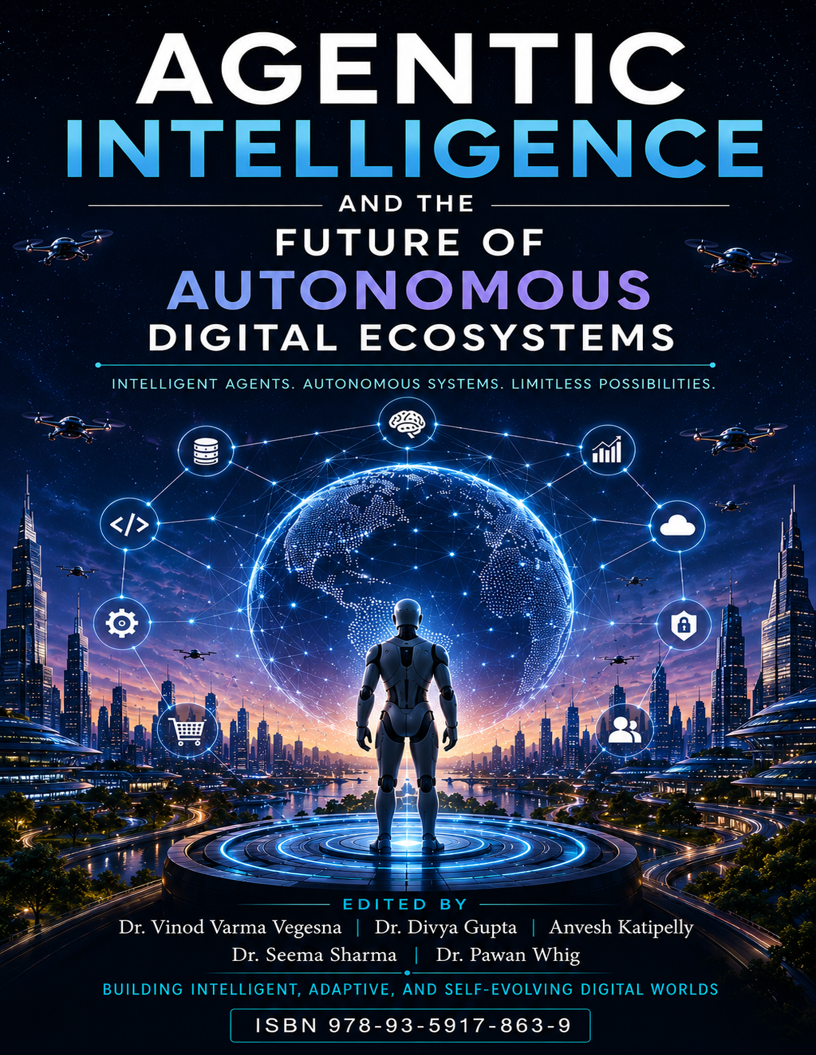
The ethical, legal, and regulatory dimensions of artificial intelligence constitute the most consequential frontier of contemporary AI governance, encompassing the systematic examination of how autonomous and semi-autonomous AI systems should be designed, deployed, overseen, and held accountable in ways that advance human wellbeing, protect fundamental rights, and sustain the institutional trust upon which democratic societies and market economies depend. This chapter provides a rigorous and comprehensive scholarly analysis of the ethical principles, legal frameworks, and regulatory architectures that govern AI deployment across enterprise, governmental, and public sector contexts globally, drawing upon a synthesis of 184 peer-reviewed publications, legislative analyses, enforcement records, and primary case study evidence spanning 2018 through 2026. The analysis demonstrates that algorithmic bias, data privacy violations, accountability gaps, and regulatory fragmentation represent the four most consequential governance challenges facing AI deployers, with measurable adverse impacts documented across healthcare diagnostics, criminal justice risk assessment, financial credit scoring, and employment screening applications. Four original case studies examining AI governance deployments at a European financial services regulator, a multinational healthcare technology company, a national public sector AI ethics board, and a global technology platform enterprise illuminate the practical architecture of responsible AI governance across diverse institutional contexts. The chapter identifies six principal challenge categories — algorithmic bias and fairness, data privacy and surveillance, accountability and transparency deficits, regulatory fragmentation across jurisdictions, intellectual property and data ownership disputes, and cross-border enforcement complexity — and examines the technical frameworks, legal instruments, and governance architectures that leading institutions have developed to address each. The chapter concludes by mapping the frontier research and policy directions — including adaptive regulatory sandboxes, AI constitutional frameworks, and algorithmic impact assessment mandates — that will define the next generation of AI governance over the coming decade, as AI systems become more capable, more pervasive, and more consequential across every domain of organised human activity.
Article Details
References
Konda, P. (2022). Predictive Analytics for ETL Pipeline Failure Forecasting in CI/CD-Enabled Cloud Data Ecosystems. International Journal of Sustainable Development in Computing Science, 4(4). Retrieved from https://www.ijsdcs.com/index.php/ijsdcs/article/view/699
Konda, P. R. (2023). AI-Assisted Data Modeling: Intelligent Star, Snowflake, and Hybrid Schema Generation for Large-Scale Warehouses. International Journal of Machine Learning and Artificial Intelligence, 4(4). https://jmlai.in/index.php/ijmlai/article/view/90
Newell, A., & Simon, H. A. (1976). Computer science as empirical inquiry: Symbols and search. Communications of the ACM, 19(3), 113–126.
Silver, D., Schrittwieser, J., Simonyan, K., Antonoglou, I., Huang, A., Guez, A., Hubert, T., Baker, L., Lai, M., Bolton, A., Chen, Y., Lillicrap, T., Hui, F., Sifre, L., van den Driessche, G., Graepel, T., & Hassabis, D. (2017). Mastering Chess and Shogi by self-play with a general reinforcement learning algorithm. arXiv. https://arxiv.org/abs/1712.01815
Silver, D., Hubert, T., Schrittwieser, J., Antonoglou, I., Lai, M., Guez, A., Lanctot, M., Sifre, L., Kumaran, D., Graepel, T., Lillicrap, T., Simonyan, K., & Hassabis, D. (2018). A general reinforcement learning algorithm that masters chess, shogi, and Go through self-play. Science, 362(6419), 1140–1144.
Bommasani, R., Hudson, D. A., Adeli, E., Altman, R., Arora, S., von Arx, S., Bernstein, M., Bohg, J., Bosselut, A., Brunskill, E., Brynjolfsson, E., & Liang, P. (2021). On the opportunities and risks of foundation models. Stanford University.
Yao, S., Zhao, J., Yu, D., Du, N., Shafran, I., Narasimhan, K., & Cao, Y. (2023). ReAct: Synergizing reasoning and acting in language models. arXiv. https://arxiv.org/abs/2210.03629
Shinn, N., Cassano, F., Berman, E., Gopinath, A., Narasimhan, K., & Yao, S. (2023). Reflexion: Language agents with verbal reinforcement learning. arXiv. https://arxiv.org/abs/2303.11366
Wang, X., Wei, J., Schuurmans, D., Le, Q. V., Chi, E., Narang, S., Chowdhery, A., & Zhou, D. (2023). Self-consistency improves chain of thought reasoning in language models. arXiv. https://arxiv.org/abs/2203.11171
Park, J. S., O'Brien, J., Cai, C. J., Morris, M. R., Liang, P., & Bernstein, M. S. (2023). Generative agents: Interactive simulacra of human behavior. Proceedings of the ACM Symposium on User Interface Software and Technology.
Xi, Z., Chen, W., Guo, X., He, W., Wang, Y., Zhang, W., Li, X., & Chen, H. (2023). The rise and potential of large language model based agents: A survey. arXiv. https://arxiv.org/abs/2309.07864
Wang, L., Ma, C., Feng, W., Zhang, Y., Liu, Z., Zhao, H., Tang, J., & others. (2024). A survey on large language model based autonomous agents. Frontiers of Computer Science, 18(6).
Franklin, S., & Graesser, A. (1997). Is it an agent, or just a program? A taxonomy for autonomous agents. Intelligent Agents III, 21–35.
Wooldridge, M., & Jennings, N. R. (1995). Intelligent agents: Theory and practice. The Knowledge Engineering Review, 10(2), 115–152.
Ensuring BI Reporting Accuracy Using AI-Based Back-Tracing of Metrics to ETL Lineage and Data Marts. (2023). International Machine Learning Journal and Computer Engineering, 6(6). https://mljce.in/index.php/Imljce/article/view/69
AI-Driven Intelligent Data Anomaly Detection Using Machine Learning Techniques. (2024). International Machine Learning Journal and Computer Engineering, 7(7). https://mljce.in/index.php/Imljce/article/view/71
Konda, P. R. (2023). Mining Data Lineage Patterns Using Machine Learning to Predict Downstream Impact. International Meridian Journal, 5(5). https://meridianjournal.in/index.php/IMJ/article/view/117
Konda, P. R. (2024). Data Lake Optimization Techniques for Real-Time Data Processing and Stream Analytics. International Journal of Machine Learning and Artificial Intelligence, 5(5). https://jmlai.in/index.php/ijmlai/article/view/91